

The Growth Scheme
The Growth Scheme is a visual manifesto of the movement from horizontal existence toward an inner vertical axis.
Most of our lives unfold horizontally — within habits, social roles, expectations, and inherited narratives about who we are supposed to be. We become so accustomed to these structures that we mistake them for reality itself. Yet there comes a moment when the structure begins to crack. What once seemed permanent reveals its fragility. Our certainties dissolve, familiar meanings collapse, and life confronts us with what cannot be controlled or explained.
This is where the vertical dimension begins.
Looking back, I see The Growth Scheme as a strangely prophetic work. It was created shortly before war entered our lives, yet today I recognize in it another battlefield — the inner one. The painting seemed to understand something long before I did. At the time of its creation, it was wiser than its author. Even now, years later, I continue to learn from it.
The work presents a sequence of human figures suspended between falling and rising. At first glance, they appear to descend. Yet the longer one remains with the image, the less certain that interpretation becomes. Is this a fall, or an ascent? Is something being lost, or discovered? From the perspective of the ego, it may look like collapse. From the perspective of spirit, it may be a return.
Beneath the figures lies a geometric framework — a diagram, a system, an attempt to organize life into comprehensible structures. It appears stable and rational, yet it is the first thing that begins to disappear. Every scheme seeks to explain reality, but reality always exceeds the scheme. Every concept attempts to contain life, while life itself remains larger than any concept.
The figures move; the structure remains still.
This tension became central to the work. Human growth does not follow a blueprint. Transformation rarely unfolds according to a plan. What we call development often begins with disorientation, uncertainty, and the loss of familiar coordinates.
The shifting luminous heads suggest changing perspectives, changing identities, changing stories. Yet something remains constant throughout the entire sequence: a silent witnessing presence. The observer within. The part of ourselves that survives every transformation without being reduced to any single role, belief, or experience.
The turquoise field surrounding the figures is often interpreted as sky or water. For me, it is neither. It is space itself — the space in which human experience unfolds. We usually identify with the figure moving through life, the one who succeeds, fails, falls, and rises. Yet the work quietly proposes another possibility: perhaps we are not only the figure. Perhaps we are also the space that contains the movement.
Seen from this perspective, the opposition between falling and flying begins to dissolve. Loss and discovery, destruction and renewal, involution and evolution become different expressions of the same process. Life moves simultaneously in many directions, and growth is rarely linear.
The Growth Scheme is ultimately not about certainty. It is about surrendering certainty. It is about allowing old structures to dissolve so that something more essential may emerge. It is about the courage to encounter oneself beyond inherited definitions.
I do not see this painting as an image of transformation. I see it as transformation itself — a process still unfolding, both within the work and within me.
Perhaps that is why this painting has remained alive for me through the years. I did not create it once and leave it behind.
In many ways, it continues to create me.
Yulya Demina
OTHER FORMS OF EXISTENCE
-
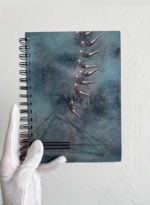
Notebook-Book
₽3,300 Write to Author -
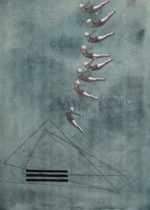
Original print
Price range: ₽7,000 through ₽33,000 Write to Author This product has multiple variants. The options may be chosen on the product page